

How to Write Medical Practice SOPs Without a Blank Page
Most medical practice SOPs start with a request: “Can you write up what you do?”
What comes back is usually one of two things. Nothing, because the person is already flat out. Or a description of how the task should be done, rather than how it actually is.
There’s a better way to write medical practice SOPs and it doesn’t involve anyone sitting in front of a blank page. It’s the method I use with practices and it lines up closely with the System for Creating Systems that David Jenyns sets out in Systems Champion.
Step 1: Choose which medical practice SOPs to write first
Don’t try to document everything. The book suggests a simple test for each task. Is it essential? Is it repeatable? Could someone else do it if it was written down?
Choose tasks that are already working. Documenting something you’d like to start doing creates a document no one follows.
David suggests no more than seven systems per area of the business. In a practice, that might mean seven for the front desk, seven for billing, seven for clinical support and so on. For your very first one, pick something simple so you learn the method.
Give it a clear name that starts with a verb, such as “Processing a new referral” or “Banking at end of day”. It makes it easier to find later.
Step 2: Record the person who does it best
Find the person who does the task most reliably. Explain why you’re recording: to capture their know-how, not to judge it.
Then record them doing the task, talking it through as they go. Screen recording works for anything on the computer. A phone works for anything away from it.
A few tips from the book’s lessons on capturing know-how:
- ask them to slow down, because experienced people move through steps without noticing
- keep asking “why?”, because the reason behind a step helps people make good decisions
- capture the usual path, not every exception; exceptions get escalated to someone experienced.
Recording the task is the fastest way to start medical practice SOPs
Step 3: Let AI produce the first draft
Transcribe the recording, then ask an AI tool to turn the transcript into numbered steps. The book estimates this gets you 80 to 90 percent of the way in minutes.
Then read every step. AI can misunderstand, skip a step or tidy away a detail that matters. Keep patient information out of general AI tools and keep clinical content within your clinical governance.
Step 4: What good medical practice SOPs include
The book lists seven parts that most good systems share. I find this a helpful checklist for medical practice SOPs:
- Title: what the procedure achieves.
- Purpose: why it matters.
- Trigger: what starts it.
- Inputs: what you need before you begin.
- Steps: the process in order.
- Endpoint: how you know it’s done and what happens next.
- Resources: templates, links and examples.
Write conversationally, the way you’d explain it to a colleague. The book warns against writing for the lowest possible skill level. Capable staff find over-explained procedures frustrating and you can lose good people that way.
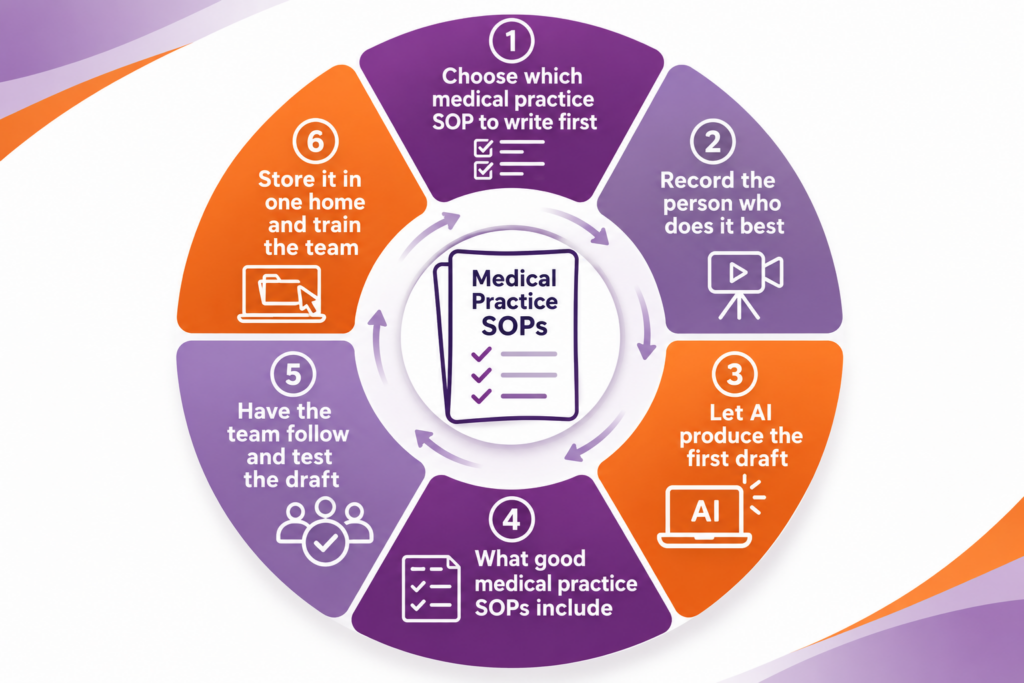
Step 5: Have them follow the draft
This is the step most practices skip. Rather than asking the person to read the draft, ask them to use it the next time they do the task. Gaps and wrong steps show up immediately.
Before I became a Certified SYSTEMologist, one of my own procedures was titled End of Day Banking, but the steps inside were for bank reconciliation. A single test run would have caught it. Now every procedure is tested by the person who does the task before it’s saved.
Step 6: Store it in one home and train the team
Save all your medical practice SOPs in one place, organised in a way the team will recognise. Then hand it to whoever oversees that task to train the team.
The book’s training approach is simple. Show them. Do it together. Then watch them do it alone, until they can do it without help.
Finally, update the procedure whenever the task changes. Not on a fixed annual schedule, but whenever it needs it.
Common mistakes with medical practice SOPs
Most problems with medical practice SOPs come from a handful of habits.
- Writing the ideal instead of the real. If the SOP describes how the task should work rather than how it does, the team quietly ignores it.
- Writing too much. A procedure that covers every possible exception is hard to follow. Capture the usual path and say who to ask when something unusual comes up.
- Saving it somewhere no one looks. A procedure buried in a personal folder or an old email might as well not exist.
- Skipping the test. A draft that hasn’t been followed by someone doing the task is still a draft.
- Treating it as finished. Practices change. A procedure that isn’t updated when the work changes becomes the reason people stop trusting the others.
If your team has stopped using procedures that already exist, the reason may not be the writing at all. Medical Practice Procedures: 3 Reasons Why Staff Dont Follow looks at the three reasons and the fix for each.
Before You Ask Anyone to Write a Procedure
If there’s a task in your practice that only one person really knows, start there. Book thirty minutes, record them doing it and let the draft do the heavy lifting.
The free guide Document It As It Runs Today will help you capture it accurately the first time. It includes a fillable Process Capture Sheet, so you can start writing medical practice SOPs straight away
Working With Denise Pacey
If you’d like help turning what your team knows into clear, usable procedures, Denise can work alongside your team or your Systems Champion. Denise works with health practices across Australia to capture how work is really done and build the operational structure that keeps it consistent.
About Denise Pacey
Denise Pacey is the founder of Pace MediSystems and a Certified SYSTEMologist with over two decades of experience in specialist medical practice management. She works with health practices across Australia in three areas: practice systemisation, Xestro implementation and coaching and mentoring.
Pace MediSystems. Systemise for Success.
Related reading: