

You’ve written the medical practice procedures. You’ve shared them with the team. A few weeks later, the same steps are being missed.
The usual conclusion is that someone isn’t trying hard enough. Sometimes that’s true. More often, it isn’t. Most medical practice procedures are skipped for one of three reasons, and only one of them is about attitude.
When I stepped into my first practice manager role, nobody trained me. I worked it out as I went. If I’d missed a step in those early months, it wouldn’t have been because I didn’t care. It would have been because nobody had shown me how.
Three reasons, not one
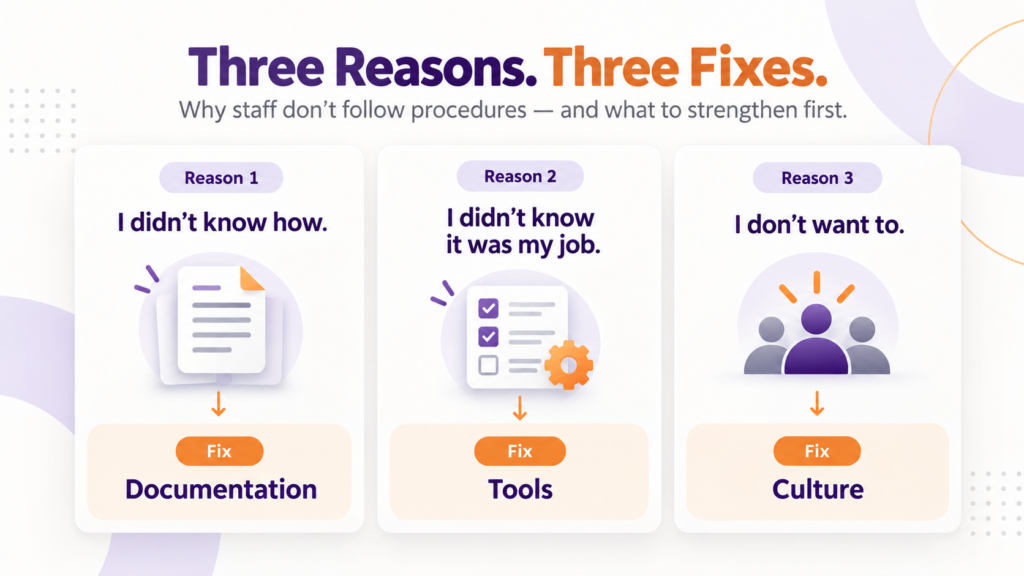
In Systems Champion, David Jenyns says he has heard hundreds of excuses for not following a process and nearly all of them come down to just three.
- “I didn’t know how.” The most common and the easiest to fix. The medical practice procedure isn’t written down, is hard to understand or can’t be found when it’s needed. Sometimes the person doesn’t know what a good result looks like.
- “I didn’t know it was my job.” This shows up as tasks that slip through the cracks or confusion about who does which part. It’s a clarity problem, not an effort problem.
- “I don’t want to.” This is about motivation. It sounds like “I don’t have time” or “the old way works fine”. It’s the hardest of the three and it’s the one people tend to assume first.
Only the third reason is about motivation. The first two are gaps the practice can close.
Each reason has its own fix
The book pairs each reason with one of three pillars. Think of them as vital signs for your practice’s systems: each one matters and the practice only runs smoothly when all three are healthy.
- Documentation answers “I didn’t know how”. A clear procedure, written for a capable colleague rather than a beginner and never more than one click from the task it belongs to.
- Tools answer “I didn’t know it was my job”. Somewhere everyone can see who is doing what by when, with each task linked to its procedure. Email chains and sticky notes can’t do this.
-
Culture answers “I don’t want to”. How the team talks about systems, who goes first and whether following the procedure is simply how things are done. Medical practice procedures stick when all three pillars are healthy.
Getting medical practice procedures followed: start with the weakest pillar
The pillars depend on each other. The best medical practice procedure is useless if no one can find it. Task software becomes shelfware if the team doesn’t believe in it. A culture talk can’t fix a procedure that was never written.
The mistake I see most is fixing the wrong pillar. A team meeting about “following procedures” when the procedure doesn’t exist. A new document when the real gap is that nobody owns the task.
Take a common example. Reception keeps booking patients without checking the referral is still valid, and the problem only shows up at billing. A reminder at the team meeting rarely changes anything. Ask the three questions instead. Is the referral check written into the booking procedure, and can staff find it when they need it? Is it clear whether reception or the billing team owns the check? If both answers are yes and it’s still being missed, that’s a culture conversation. Most of the time, the gap is in the medical practice procedures themselves, not the people following them.
Before you act, work out which reason you’re dealing with. Then strengthen that pillar first.
Who fixes what
There’s one more point in the book worth knowing. The person who owns your systems is not the disciplinarian. Their job is to make the right way the easy way, so that a missed step is obvious without anyone playing detective.
If someone has been shown how, knows it’s their job and still won’t follow the procedure, that conversation belongs to their manager.
Before Your Next Team Meeting
If you’re about to raise “following procedures” with the team, pause first. Pick the one practice procedure that’s being missed most and ask three questions. Is it written down and easy to find? Is it clear who owns it? Have the people involved said they don’t want to do it?
The answer tells you which fix to start with. The Practice Operations Self-Assessment can help you see which pillar needs attention first
Working With Denise Pacey
If your team is missing the same steps no matter how many reminders go out, I can help you work out why. Denise works with health practices across Australia to find the real reason procedures aren’t followed and build the operational structure that makes the right way the easy way.
About Denise Pacey
Denise Pacey is the founder of Pace MediSystems and a Certified SYSTEMologist with over two decades of experience in specialist medical practice management. She works with health practices across Australia in three areas: practice systemisation, Xestro implementation and coaching and mentoring.
Pace MediSystems. Systemise for Success.
Related reading: