

Medical Practice Culture: Keeping Systems in Use
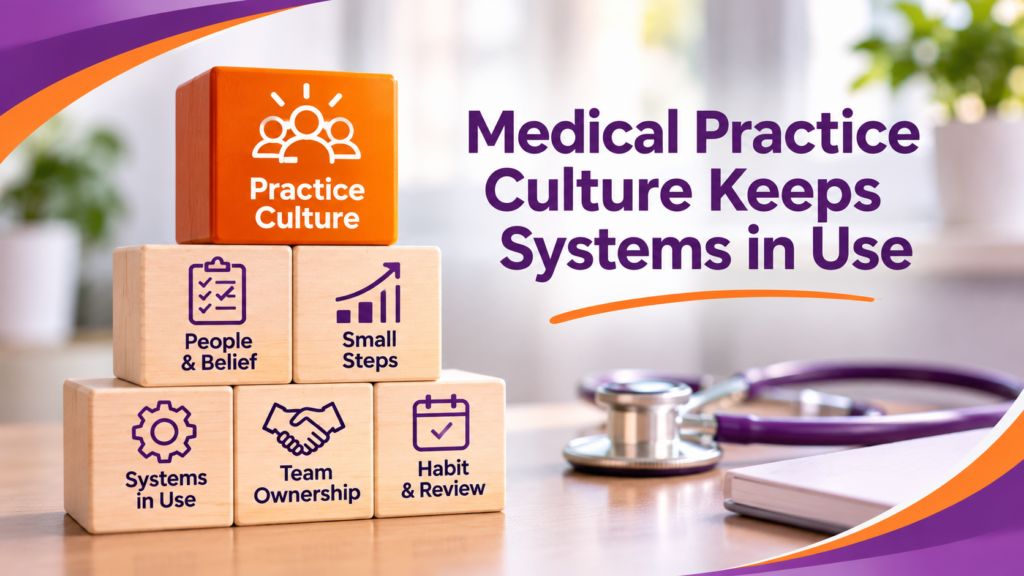
You can write excellent procedures and set up the right software and still find the team doing things the old way three months later. That’s where medical practice culture comes in.
In Systems Champion, David Jenyns calls culture the final and hardest of his three pillars. Documentation solves “I didn’t know how”. Tools solve “I didn’t know it was my job”. Culture is what answers “I don’t want to”.
It’s a common pattern. A practice documents its recall process, saves it in a shared folder and announces it at a team meeting. Three months later, half the team is still using the old spreadsheet. The procedure isn’t the problem. Nobody has shown the team why it matters or who is leading it.
Start with belief
The book makes a point I found useful. Being given the systems job doesn’t automatically mean someone believes in it. If the person leading the work can’t explain why it matters, the first sceptic will knock them over.
One of the beliefs in the book is worth adopting straight away: every problem is a systems problem. When something goes wrong, look at the process before looking for someone to blame. A missed recall usually points to a gap in how recalls are set up, not to a careless person.
That one shift changes the tone of a practice. Finger-pointing turns into problem-solving. That’s the foundation of a healthy medical practice culture.
Start with the willing, not the resisters
The book uses a well-known festival video to explain how movements start. One person dancing alone looks odd. The first person to join changes everything. Then others start to follow the followers.
The lesson for a practice is simple. Don’t spend your early energy on the one person who pushes back. Find the people who are keen and work with them first.
Make it easy, with small steps. Make it obvious, with procedures one click from the task. Make it a bit of fun, by celebrating the wins. When the rest of the team sees it working, many will come along on their own.
The book’s allied health example shows this. A young occupational therapist was given protected time to lead the systems work. Before long, colleagues were asking to be part of what he was doing.
Build a medical practice culture with proof
David suggests imagining a courtroom where you need to prove your practice is systems-driven. What evidence would you have?
In a practice, proof can be simple:
- a systems item on every team meeting agenda
- a short message when a new procedure goes live
- a visible list of systems marked not started, in progress or done
- thanking the person who suggested an improvement
- before and after examples, such as time saved or errors avoided.
Over time, the evidence builds until following the system is “how we do things here”. That’s what a strong medical practice culture looks like from the inside.
Expect habits to take time
The book debunks the idea that a habit forms in 21 days. It cites a University College London study where the average was almost 70 days, with a wide range either side.
That’s why one email or one meeting rarely changes how a team works. Short, regular sessions work better. Five minutes on one procedure in each weekly meeting does more than an annual training day.
Fix it when you notice it
A regular check of your procedures helps you spot what has drifted. I’ve recommended a review rhythm before and it still matters. The trap is letting that review become the only time anything gets fixed.
The book makes the point well. If a practice reviews everything once a year, often just before accreditation, people start waiting for the review to fix something they already know is wrong. Updating a procedure when the way you work changes is a small job. Saving it up for a yearly overhaul makes it a big one.
Make it easy for anyone to flag a procedure that’s out of date and fix it then. The team is your best early warning.
Signs your medical practice culture is working
Culture is hard to measure, but there are signs worth watching for:
- New staff ask “where’s the procedure?” rather than “who do I ask?”
- Mistakes lead to a process change, not a conversation about who got it wrong.
- Team members suggest improvements without being asked.
- Procedures come up naturally in team meetings, not only when something has gone wrong.
- The practice runs smoothly when someone experienced is away.
If you’re seeing two or three of these, your medical practice culture is moving in the right direction. If you’re seeing none, start with the willing and build from there.
Recruitment and onboarding
New team members are the easiest people to bring into a systems culture, because they’re looking for cues about how things are done. I’ve written about this in more detail in Recruitment, Onboarding and the Systems That Help Good People Stay and Poor Onboarding in Medical Practices: The Hidden Costs.
Before You Push Harder
If your team isn’t using the procedures you’ve built, resist the urge to send another reminder. Check first that the procedure is written down and easy to find and that everyone knows who owns it. Why Staff Don’t Follow Medical Practice Procedures explains how to tell which problem you’re dealing with.
If it is a culture problem, ask who in the team would be first to join and start with them. Then pick one small piece of proof to build this month.
Working With Denise Pacey
If you’d like help building a medical practice culture where your systems actually get used, Denise can support your Systems Champion through mentoring or work with your team directly. Denise works with health practices across Australia to make systems part of everyday work and build the operational structure that lasts beyond the first month.
About Denise Pacey
Denise Pacey is the founder of Pace MediSystems and a Certified SYSTEMologist with over two decades of experience in specialist medical practice management. She works with health practices across Australia in three areas: practice systemisation, Xestro implementation and coaching and mentoring.
Pace MediSystems. Systemise for Success.
Related reading: Recruitment, Onboarding and the Systems That Help Good People Stay