

Every June, specialist and allied health practices go through the same ritual as part of their EOFY review. The accountant sends the end of financial year (EOFY) checklist. The bookkeeper reconciles the accounts. The practice owner or manager reviews the income against what they were hoping for, notes what came in and what went out and start thinking about targets for the new financial year. That review matters. It should happen. The numbers tell you something important about how the year went. But they only tell you half the story.
Behind every financial result is a set of operational behaviours that produced it. Workflows that ran well or ran badly. Processes that were followed consistently or quietly abandoned. Systems that supported the team or left them finding workarounds to get through the day. The income that was collected. The income that was not. The operational review is the review that tells you why the numbers look the way they do. It is the review that most practices never do. It is also the one that changes what the next financial year looks like.
The financial review tells you what happened. The operational review tells you why.
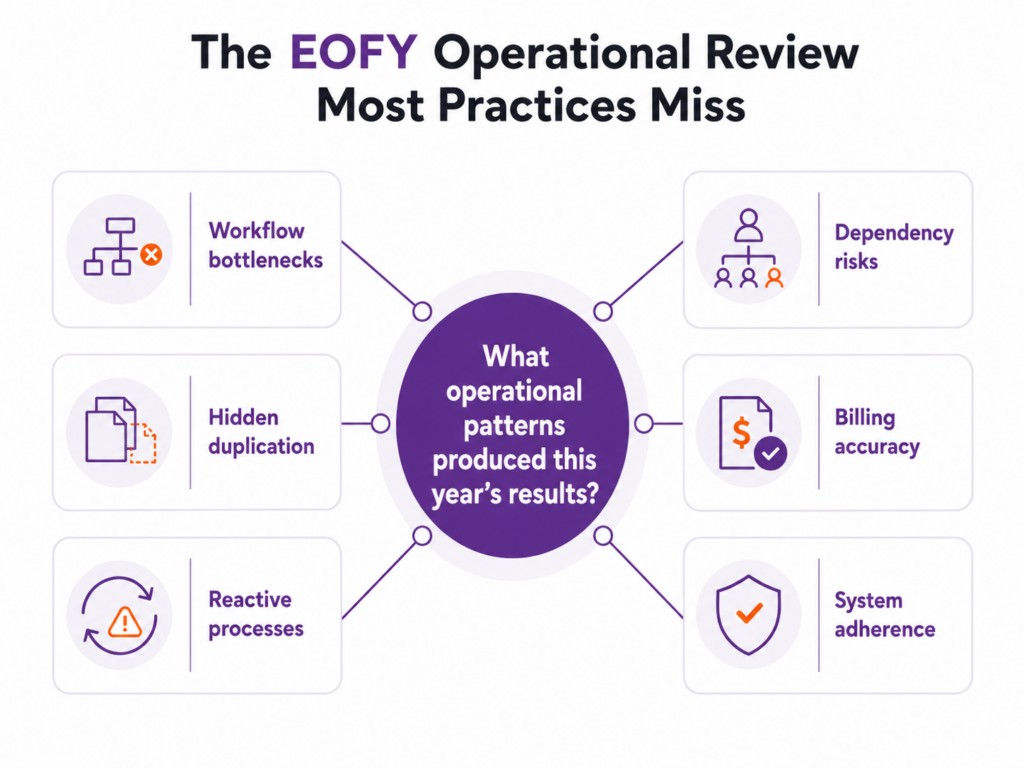
This article walks through six operational areas worth reviewing honestly before you set your targets for the new financial year. Work through each one as part of your EOFY review and ask yourself where the practice lost ground this year, not just financially, but operationally.
EOFY Review Area 1: Workflow Bottlenecks
Where did work consistently slow down or stop this year?
Every practice has them. The step that requires a specific person to be present. The task that always gets pushed to tomorrow. The process that works fine when the team is fully staffed and falls apart the moment someone is away.
Bottlenecks are rarely dramatic. They show up as small delays: a referral that sits in someone’s inbox for two days, a booking that does not get made because the person who knows how to do it is with a patient, an invoice that does not get raised until the end of the week because the billing coordinator is the only person who handles it.
Individually each delay feels manageable. Collectively across a full financial year they represent a significant amount of time the practice spent waiting for work to move rather than actually moving it.
Review question: Where did the practice consistently wait for work to move this year? Which tasks required the same person every time?
EOFY Review Area 2: Hidden Duplication
Where was the same task being done more than once this year?
Double handling is one of the most expensive hidden costs in specialist & allied health medical practice administration. It does not show up as a line item. It shows up in staff capacity that is quietly consumed by work that should only need to happen once.
Data entered in one system and re-entered in another. An email followed up with a phone call that should not have been necessary. A document recreated because the original was not stored where others could find it. A task created to track a booking that should simply have been made.
In one practice, a team member spent the better part of a morning creating individual tasks for a list of patients who needed to be booked. Had she spent that same time making the actual bookings, the majority would have been done before lunch, reducing the task list rather than just documenting it. The system she was working around already had the capability to handle it. The workaround felt productive. It was not.
Double handling is rarely a people problem. It is almost always a workflow design problem: a system that does not connect the steps, a process that was never mapped end to end, a team that adapted to what was available rather than what was designed.
Review question: What tasks in your practice get handled more than once? Where is the same information being entered in two places?
EOFY Review Area 3: Reactive Processes
Which processes only happened this year because something went wrong first?
A reactive process is one that exists to fix a problem rather than prevent it. The deposit chased after the appointment rather than collected before it. The referral checked at the time of billing rather than at the time of booking. The health fund rejection followed up weeks later rather than the day it came back.
Reactive processes feel necessary because by the time they kick in, something has already gone wrong and action is required. But the cost is always higher than prevention would have been. The deposit that needs chasing is harder to collect than the one taken upfront. The referral discovered to have expired at billing is significantly more difficult to resolve than one checked when the appointment was made.
The referral validity issue deserves particular attention in specialist practices. A patient provides a valid referral at the time of booking. The appointment is scheduled weeks or months ahead. By the time the procedure takes place, the referral has expired. Nobody checked. The Medicare claim fails. The practice either wears the cost of pursuing a new referral or loses the ability to claim entirely. This is not a billing problem. It is a workflow design problem that surfaces at billing.Every reactive process is a preventable process waiting to be redesigned.
Review question: Where did the practice fix things this year that could have been prevented with a better-designed workflow?
EOFY Review Area 4: Dependency Risks
Where in the practice does knowledge live in people instead of systems?
Every specialist & allied health practice has at least one person like this. The team member who knows where things are stored in the system, which patient needs to be handled carefully, the step nobody wrote down because she has always just done it. When she is there, the practice runs efficiently. When she is not, things fall apart.
This is not a reflection on the person. It is a reflection on the structure around her. When knowledge lives in a person rather than a process, the practice is only ever one resignation, one sick day or one unexpected absence away from a gap.
The gap is not always visible immediately. It shows up in the patient who was not followed up, the referral that was not checked, the task that nobody knew existed until it did not get done.
At the end of a financial year, it is worth mapping where the practice is one person away from a problem. Not to remove those people. They are often the most capable and committed members of the team. But to build the systems around them that mean the practice does not depend on their presence to function.
Review question: What would stop working in your practice if your most knowledgeable team member was away for a month? What knowledge exists only in someone’s head?
EOFY Review Area 5: Billing Accuracy
Were Medicare claims, health fund submissions and gap payments processed correctly and on time this year?
Specialist medical billing is complicated. Medicare item numbers, health fund schedules, referral validity periods, gap payments, deposits, procedure codes. Every step in that chain is an opportunity for something to be missed.
When billing workflows are inconsistent, when different team members handle the same billing task differently, when there is no clear process defining who does what and when, when rejections sit unactioned because nobody owns the follow-up, the gaps accumulate.
By EOFY those gaps show up as outstanding accounts. Practices instinctively respond by focusing on collections. But collections are the last line of defence, not the first. The practices that carry the least debt at EOFY are not necessarily the ones with the best collections process. They are the ones with the best billing workflows, designed to capture income correctly at every step of the patient journey, before there is anything to chase.
Review question: Where did billing inconsistency cost the practice income this year? Were rejections followed up? Were deposits consistently collected before procedures?
EOFY Review Area 6: System Adherence
Were processes being followed consistently across the whole team this year?
System adherence is the gap between how a process is designed to work and how it is actually being used day to day. It is the most common and least visible source of operational drift in specialist & allied health practices.
One person doing something differently is a habit. Two people doing it differently is a pattern. A whole team doing it differently is a new standard that nobody agreed to, one that is quietly undermining the value of the systems that were put in place.
System adherence does not erode through dramatic decisions. It erodes through small adjustments made under pressure. The workaround that works faster in the moment. The step that gets skipped when the day is busy. The process that everyone knows exists but nobody follows consistently because following it takes longer than not following it.
If the processes are not being followed, there are two possibilities. Either the process needs to be better designed: simpler, faster, more integrated into how the team actually works. Or the team needs clearer guidance, better training and a feedback structure that makes it safe to raise problems rather than quietly work around them.
Review question: Where did workarounds quietly replace the agreed process this year? Are there systems in place that the team is not using consistently?
Your Next Step Before July Begins
Work through these six areas before you set your financial targets for the new year. Not all at once. Pick the one or two that you already know are creating the most pressure and start there.
The point of this review is not to identify everything that went wrong. It is to understand what the numbers are actually telling you about the operational patterns behind them, so that the targets you set for July are built on something real, not on hope that the same patterns will somehow produce different results.
New targets on old patterns produce old results.
The operational review is not an add-on to the EOFY process. It is the part that makes the financial review useful.
Working With Denise Pacey
If working through these six areas has surfaced problems you are not sure how to address, or if you are heading into the new financial year knowing that the operational patterns need to change but not knowing where to start, this is exactly the work Pace MediSystems is designed to support.
Denise works with specialist and allied health practices across Australia to systemise operations, redesign workflows and build the structural foundations that allow practices to grow without depending on specific people showing up every day to hold things together.
About Denise Pacey
Denise Pacey is the founder of Pace MediSystems and a Certified SYSTEMologist with over two decades of experience in specialist medical practice management. She works with medical practices across Australia in three areas: practice systemisation, Xestro implementation and coaching/mentoring.
Pace MediSystems. Systemise for Success.