

Software implementation succeeds or fails long before go-live. Why do some practices implement new practice management software and hit the ground running, while others are still fighting it six months later? It’s rarely the software itself.
Two specialist practices migrate to Xestro within the same month. Both get access to exactly the same features: the same ability to set up automated appointment reminders, tasks linked to appointment types, and integrated EFTPOS.
Six months later, one of them has done that setup. Its reminders go out automatically, the right tasks fire the moment an appointment is booked, and payments reconcile straight through EFTPOS without anyone touching a separate terminal. The other hasn’t. Its front desk is still ringing every patient the day before, chasing paperwork manually because nothing prompts them to, and reconciling payments by hand, the same as they did on Genie, because nobody ever switched the automation on.
The difference shows up in where everyone’s time actually goes. The practice that switched the automation on has staff hours back, and that time is going into the parts of the job software can’t do: more time with patients, more attention on the details that make a consultation feel unhurried. The other practice is still running flat out just to get through the day, and staff there are starting to feel the implementation hasn’t delivered. That’s not a fair read on Xestro, it’s a fair read on how the software implementation itself was run. Same software, same features, two completely different outcomes.
Two decades in specialist medical practice management taught me this firsthand: migrating incoming specialists’ data into our practice’s platform every time one joined, and training other practices directly as a Genie Solutions trainer. The pattern repeats itself without fail.
Leadership involvement, realistic expectations and genuine staff training and buy-in decide whether a software implementation actually holds. The feature list rarely does.
This isn’t only lived experience. A study focused specifically on small, non-hospital practices, those with five physicians or fewer, found leadership and a clear clinical champion, realistic goals set up front, and early staff communication were what separated the implementations that stuck from the ones that didn’t (Lorenzi et al., 2009). A much larger systematic review across 26 studies of health IT implementations, published in 2025, found the same pattern held at far greater scale, across hospitals, primary care and other non-hospital settings alike (Alharbi, 2025). The broader research on system adoption points the same way: practices that invest properly in training consistently report higher satisfaction and get more out of whatever system they’re running.
——————————————————————————————
Sources:
Alharbi, M.F. (2025), “Does Electronic Health Record Implementation Enhance Hospital Efficiency and Patient Outcomes? A Comprehensive Systematic Review,“ SAGE Open, 15(3). Systematic review of 26 studies across hospital, primary care and other non-hospital settings, 1994–2023.
Lorenzi, N.M., Kouroubali, A., Detmer, D.E. and Bloomrosen, M. (2009), “How to successfully select and implement electronic health records (EHR) in small ambulatory practice settings,” BMC Medical Informatics and Decision Making, 9:15. Focused on practices of five physicians or fewer.
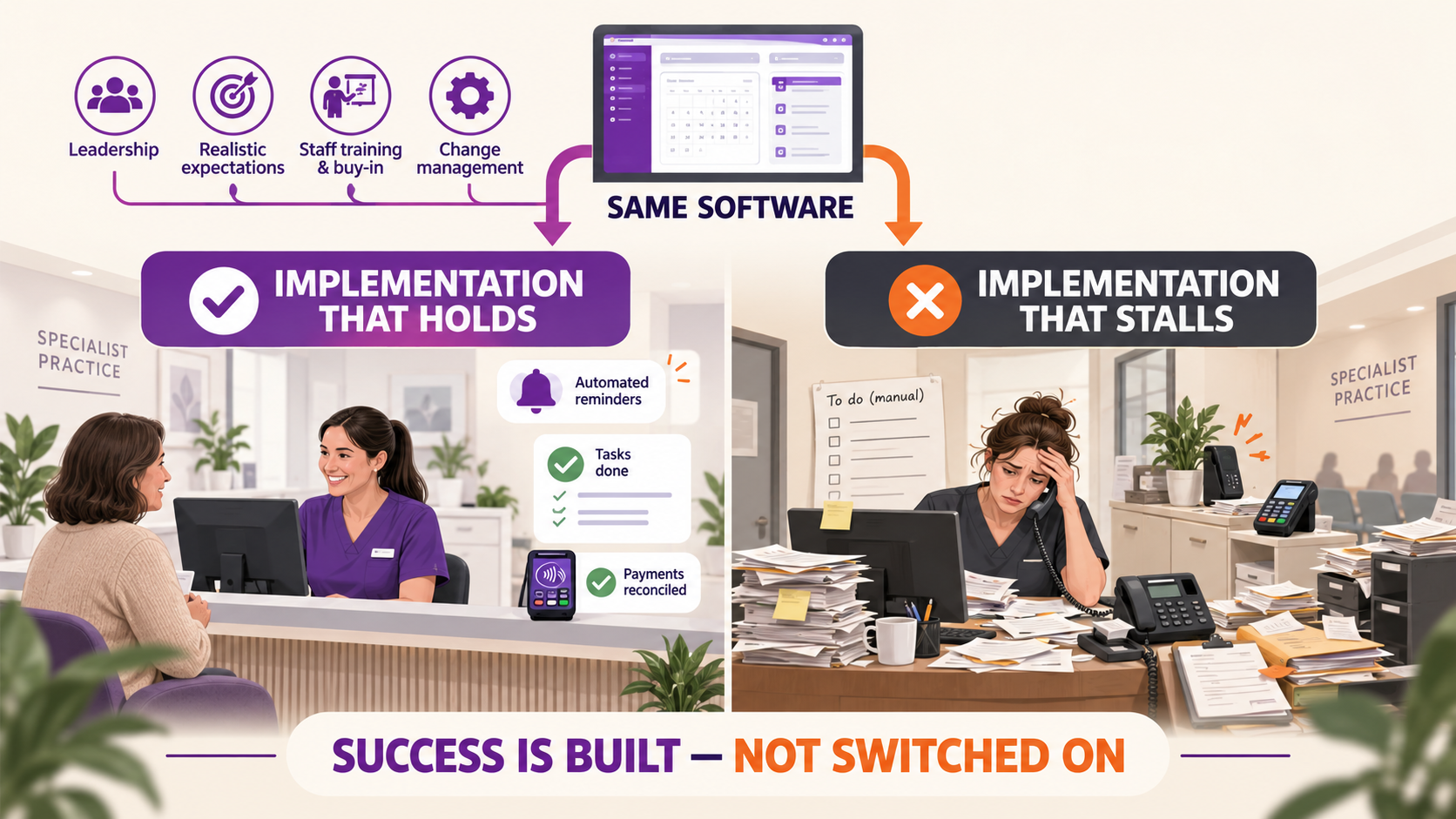
What actually predicts success
Leadership involvement. The practices that get this right have someone driving the project who stays genuinely engaged throughout, not just someone who signs off at the start. In practice, that looks like the practice manager or lead specialist reviewing setup decisions weekly through the build, not just attending the kickoff meeting and the go-live sign-off. That person is what turns capable software into a system the whole team actually uses.
Realistic expectations. Practices that go in expecting a genuine change process, not a quick switch, consistently do better than ones that treat it as a simple swap. That means budgeting real weeks for workflow redesign and staff training as part of the project, rather than treating go-live day itself as the finish line.
Staff training and buy-in. Training that continues after go-live, and staff who are genuinely engaged rather than just informed, predicts success far more reliably than any feature the software offers. A single training session before go-live, with nothing scheduled afterwards, is the most common shortfall. Practices that build in a follow-up session two or three weeks in, once staff have real questions instead of hypothetical ones, get far more out of it.
Organisational culture and change management. Trust in the process, and a willingness to customise the system to how the practice actually works rather than forcing the practice to work around the software, comes up again and again in both the small-practice and large-scale research. In practice, this is the difference between adjusting a workflow because the new system genuinely does it better, and quietly reverting to an old workaround because nobody checked whether the new way actually suited how the team worked.
What didn’t predict success
Licence cost on its own. Feature count on its own. How impressive the system looked in a demo. None of these appear as reliable predictors in either study. What both studies do flag as common failure points are limited support from doctors and nursing staff, and software forced onto a practice’s workflow rather than adapted to it.
Your Next Step
Most practices only discover which of these factors was missing from their software implementation well after go-live, once the gap is far harder to close than it would have been at the start.
The practical next step is straightforward. Whether you’re mid-implementation right now or still in the planning stage, look honestly at leadership involvement, realistic expectations, staff training and buy-in, and change management, and ask which of these are genuinely in place, and which have just been assumed.
If you’re heading toward go-live, in the middle of it, or just past it, click the link to grab the Xestro Implementation Readiness Checklist and score your own software implementation against the three steps that actually decide whether it succeeds, while there’s still time to close what it shows you.
Working With Denise Pacey
If you would like a second set of eyes on where your own implementation actually stands against these factors, that is exactly the kind of conversation worth having before problems compound.
Denise works with specialist medical practices across Australia to plan and run software implementations properly, covering setup, defined success measures and genuine change management, and build the operational structure that holds up long after go-live..
About Denise Pacey
Denise Pacey is the founder of Pace MediSystems and a Certified SYSTEMologist with over two decades of experience in specialist medical practice management. She works with medical practices across Australia in three areas: practice systemisation, Xestro implementation and coaching and mentoring.
Pace MediSystems. Systemise for Success.