

Five practice management software questions stand between most practices and real confidence that their Assignment of Benefit workflows are ready. None of these software provider questions are complicated, they simply have not been asked yet. All five are worth confirming directly with your software provider before the Assignment of Benefit transition ends on 30 June 2027, not after.
Take this to your next support call or email. Five questions, five straight answers, and you will know exactly where your practice stands.
1. Does Our System Distinguish Between Bulk Billing and Simplified Billing?
Bulk billing and simplified billing (through Eclipse) follow different Assignment of Benefit rules, different retention periods, and in some cases different consent mechanics entirely. If your system treats every claim the same way regardless of billing type, there is a real risk of applying the wrong consent process, or the wrong retention period, without anyone noticing until it matters.
Ask your software provider directly: does the system flag which billing pathway a claim is on, and does that flag drive different consent or record-keeping steps automatically, or is that left entirely to staff to track manually?
2. Can Our System Capture and Date-Stamp Verbal Consent for Bulk Billed Services?
Verbal consent for bulk billed services remains valid until 30 June 2027, but it still needs to be documented, not just given. A verbal agreement with no record of when and how it was obtained is not going to hold up as evidence of compliance.
Ask whether your system has a built-in field or workflow step for logging verbal consent with a date and time stamp, or whether that is currently being tracked outside the system, in a notebook, a spreadsheet, or nowhere at all.
3. Does Our System Support Enduring Assignment for Eligible MyMedicare, Aged Care and ACCHO Patients?
Enduring assignment lets an eligible patient agree in advance to assign their Medicare benefit for future bulk billed services, rather than repeating the consent step at every visit. It applies specifically to patients registered with MyMedicare, residents of aged care homes, and patients of Aboriginal Community Controlled Health Organisations, and it was brought forward to take effect from 1 July 2026 alongside the broader Assignment of Benefit changes.
For a practice with a meaningful volume of patients in any of these categories, this is a genuine efficiency gain, but only if the system actually supports recording an enduring agreement rather than forcing a fresh consent capture every time. Worth confirming whether this is currently configured, or simply available but switched off.
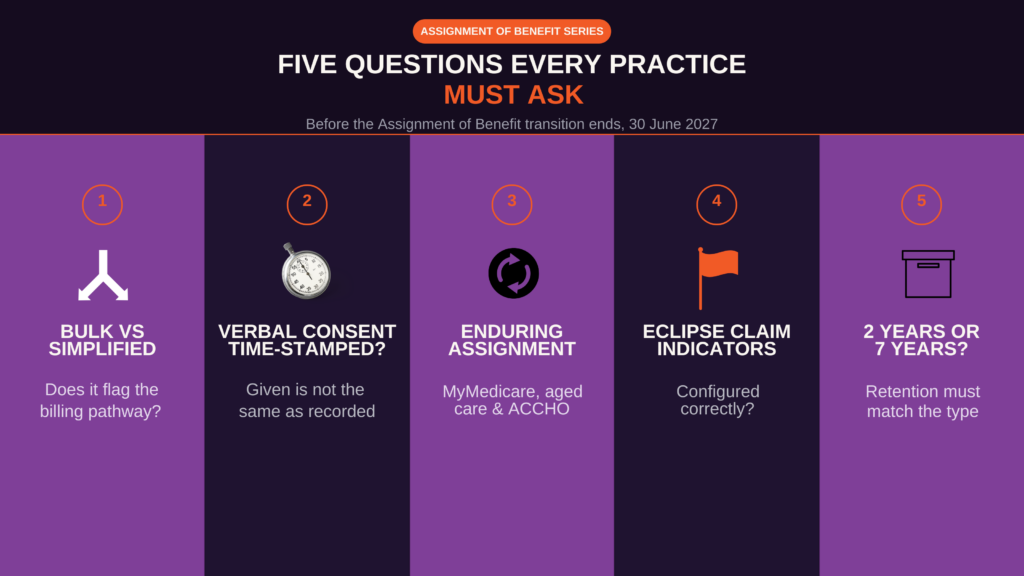
4. Are Our Claim Indicators Correctly Configured for Eclipse Claims?
Eclipse claims carry indicators that determine how a claim is processed, including whether it falls inside the no gap or known gap simplified billing band, or outside it as a private claim. Getting this configuration wrong does not just risk a compliance gap, it risks claims being processed incorrectly or rejected outright.
This one is worth a direct technical check with your software provider’s support team rather than an assumption. Ask them to confirm your current claim indicator setup and whether it correctly reflects how your practice actually bills.
5. How Long Does Our System Retain Signed Assignment Agreements, and Does That Match the Two-Year and Seven-Year Requirements?
A signed bulk billing assignment agreement needs to be kept on file for two years. A signed simplified billing agreement, where one is required, needs to be kept for seven. Two agreement types, two different retention periods, and it is easy for a system’s default archiving or document retention settings to apply one rule across the board without anyone realising the two are meant to differ.
Ask your software provider how retention is currently configured, whether it distinguishes between agreement types, and whether records are actually retrievable at the two and seven year marks, not just stored somewhere and forgotten.
Why This Is Worth Doing Now
None of these five questions are difficult to ask. What they have in common is that nobody asks them until something has already gone wrong, a claim gets queried, a record can’t be found, or an audit raises a question the practice cannot answer cleanly.
Before Your Next Support Call
If you have never put any of these five questions to your software provider, that is normal, but it will not hold up as an excuse if a claim gets queried or an audit happens. The gap is easy to close, it just has to be asked.
Save this, send it to your software provider’s support team, and get five straight answers before the transition period ends.
Working With Denise Pacey
If putting these questions to your software provider raises more questions than answers, or you would rather have someone confirm your setup directly, this is exactly the work Pace MediSystems is designed to support.
Denise works with specialist and allied health practices across Australia to review practice management software setup, close configuration gaps like these, and build the operational structure that holds up under audit.
About Denise Pacey
Denise Pacey is the founder of Pace MediSystems and a Certified SYSTEMologist with over two decades of experience in specialist medical practice management. She works with medical practices across Australia in three areas: practice systemisation, Xestro implementation and coaching and mentoring.
Pace MediSystems. Systemise for Success.
Related reading: This month’s companion post, Assignment of Benefit Changes: What Your Practice Must Do