

Assignment of Benefit Changes
On 1 July 2026, the way Australian practices capture Assignment of Benefit for bulk billed and simplified billing services changed. If your practice bulk bills, or bills through Eclipse, this affects you, whether or not anyone has flagged it yet.
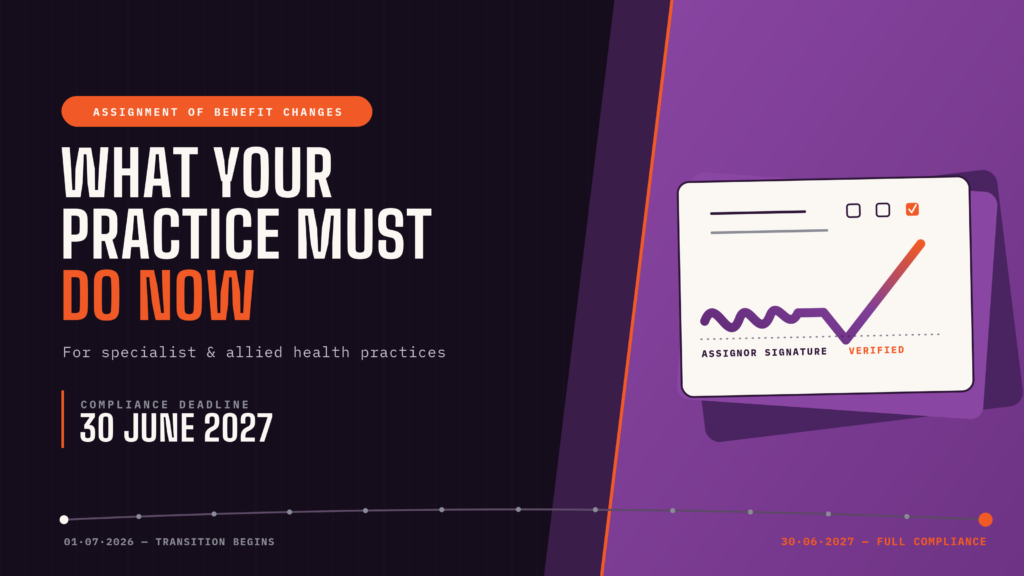
Here is exactly what changed, what the twelve-month transition period does and does not allow, and what your practice needs to have in place before it ends on 30 June 2027.
What Actually Changed on 1 July
Verbal consent for bulk billed services remains valid until 30 June 2027. That is a genuine transition period, not a loophole and not an oversight. It exists so practices have time to build a compliant, documented consent process without disrupting patient care overnight.
From 1 July 2026, it is the patient, not the provider, who signs the assignment agreement. The record-keeping onus now sits with the practice, not Medicare. For bulk billed services, that means two years on file.
The risk is treating twelve months as a reason to wait rather than a window to act. A practice that starts building its process now has time to test it, adjust it, and train staff properly. A practice that waits until May 2027 is building under pressure, with far less room to get it right.
The Forms Did Not Disappear, They Changed
The old DB4, DB4E and DB020 forms were not retired on 1 July. The old versions simply stopped being valid, and Services Australia published updated ones in their place, with a new required data set. You’ll find the current forms here: Assignment of benefit for bulk bill claims – Services Australia. That said, using the updated forms isn’t the only way to stay compliant.
Here is the part most practices miss: these forms were never made mandatory in a single fixed format. Any compliant format works, paper, electronic, or your own, provided it captures the required information and the patient signs it before the claim is submitted.
That flexibility is good news. It also means nobody is going to hand your practice a template and tell you exactly what to do next. The decision your practice actually needs to make is which format works for your workflow, and who is responsible for keeping it updated.
Two Ways to Capture It, Which Fits Your Workflow
The move away from verbal-only consent gives practices two different ways to actually capture Assignment of Benefit, and the right choice depends on how your practice runs.
- Pre-assignment is captured before the consult. It only needs a basic description of the service, not the specific item number, and it can cover ongoing episodic treatment up to six months in advance. That makes it well suited to patient information packs, forms completed in the waiting room, or something sent ahead of a telehealth appointment.
- Post-assignment is captured after the consult, and it needs to specify the actual item or items charged for the service. It suits in-clinic appointments, where a form can be handed over once the consultation is done and the billing is confirmed.
Either way, the agreement has to be in place before the claim is actually submitted. Worth deciding now which one, or which mix of both, actually fits how your practice sees patients, rather than defaulting to whichever one a template happens to use.
Does This Actually Apply to Your Billing?
This is the part most GP-focused Assignment of Benefit content overlooks, and it matters more for specialist practices than almost anyone else.
Simplified billing through Eclipse only covers no gap and known gap claims, capped at around $500. Within that band, the Assignment of Benefit changes apply to you. Go above that threshold and you are billing privately, the patient pays the account directly and may claim from Medicare or their fund themselves afterward. No assignment happens, so none of the changes touch that claim. Same specialist, same procedure, two different rules, depending on which side of $500 the fee lands.
Simplified billing exists because a private health fund is a party to the transaction, not just Medicare, which is why the assignment mechanics work differently again. Whether a claim is Implied or Requested Assignment is not something you choose by claim. It comes down to whether the treating provider already has an existing agreement with that health fund. If they do, it is Implied and no extra step is needed. If they don’t, it is Requested, and the patient’s authorisation needs to be captured before the claim is submitted.
Worth noting: a single practice can have both scenarios running at the same time, one specialist already holds an agreement with a given fund, another doesn’t. Implied and Requested Assignment aren’t a practice-wide setting, they need to be tracked provider by provider, and fund by fund.
How Long You Actually Need to Keep These Records
Two records that can look almost identical, with two very different retention requirements. A signed bulk billing assignment agreement needs to be kept on file for two years. A signed simplified billing agreement, where one is required, needs to be kept for seven.
These are the same two agreement types covered above, bulk billing consent and Eclipse simplified billing consent, and they carry different retention rules even though the paperwork can look the same once it is filed. Worth a quick check of how your practice currently stores these agreements, and whether the retention period attached to each one is actually correct.
Building This Properly, Not Just Meeting the Letter of It
None of this means the process is complicated for the sake of it. It means a data migration or a software feature will move structured data well, but a compliance change like this one needs a decision, a workflow, and a habit behind it, not just a form.
Right Now, While the Transition Period Is Still Running
Right now, while the transition period is still running, if you could not say who in your practice is responsible for capturing Assignment of Benefit correctly, or how long each record type needs to be kept, that is the gap worth closing before it becomes urgent.
Working With Denise Pacey
If Assignment of Benefit still runs on habit rather than a documented process in your practice, or you are heading toward 30 June 2027 without a clear answer for how it will hold up, this is exactly the work Pace MediSystems is designed to support.
Denise works with specialist and allied health practices across Australia to document compliance workflows, close gaps like this one, and build the operational structure that holds up under audit.
About Denise Pacey
Denise Pacey is the founder of Pace MediSystems and a Certified SYSTEMologist with over two decades of experience in specialist medical practice management. She works with medical practices across Australia in three areas: practice systemisation, Xestro implementation and coaching and mentoring.
Pace MediSystems. Systemise for Success.
Related reading: This month’s companion post, Five Practice Management Software Questions Every Practice Should Ask Before the Assignment of Benefit Transition Ends, walks through what to confirm with your provider so your system is actually handling these changes correctly.